
Reading time: ~18 minutes
In 2013, Cyprus banks froze accounts overnight and seized 47.5% of deposits over €100,000 to bail out the banking system. Legal. Instant. Your life savings became “national emergency funds” while you slept.
Maybe you’ve never faced that extreme. But you’ve felt the smaller cuts: A weekend transfer that won’t go through. An account flagged “suspicious” by an algorithm. Your money, your account—but someone else’s permission required.
Now imagine this: You carry a string of 12 words in your memory. Those words unlock $100,000 in Bitcoin that no bank can freeze, no government can confiscate, and no corporation can inflate away. You can cross borders with your wealth invisible. You can send it anywhere on Earth in minutes. You truly, completely own it.
This isn’t science fiction. It’s happening right now. But here’s the catch—most people who own Bitcoin don’t actually own it. They’re making the same mistake they made with banks, just with a different middleman.
Let me show you how Bitcoin actually works, and more importantly, how to take real custody of your digital wealth.
The Billion-Dollar Copy-Paste Problem
Picture this: You’re holding a $100 bill. You hand it to me. Now I have it. You don’t. Simple physics.
But digital money? That’s just information—ones and zeros. You can copy it infinitely. Send me a digital $100, and without a referee watching, you could send that same $100 to someone else. And someone else. Forever.
Think about that for a second. Every file on your computer can be duplicated with a single click. How do you make money work in that environment?
For decades, this “double-spend problem” killed every attempt at digital cash. DigiCash, launched by cryptographer David Chaum in 1990, failed by 1998 despite pioneering digital currency concepts [1]. E-gold, which processed over $2 billion in transactions annually by 2006, was shut down by the U.S. government in 2007 [2]. The reason? They all needed a central company to be the referee—to keep the ledger, prevent copying, verify every transaction.
Then that referee became a single point of failure. Shut down the company, and the whole system collapses.
Until 2009.
An anonymous person (or group) named Satoshi Nakamoto solved it with an idea so elegant it seems obvious in hindsight: What if everyone kept the ledger? What if instead of trusting one company, we built a system where thousands of independent computers all verify the same transaction history?
The blockchain was born—a public ledger that everyone can read, no one can alter, and math itself protects.
This is the moment where mathematics replaced trust. Where intermediaries became optional, not inevitable.
Bitcoin removed the technical necessity for middlemen in money transfer. Whether it removes the practical necessity remains an open question—but for the first time in history, that question can actually be asked. The infrastructure exists for peer-to-peer value transfer without permission from centralized institutions.
If you’re wondering why this matters—why we needed an alternative to traditional money systems in the first place—we explored the fundamental flaws in our current monetary system in depth in Before Bitcoin: Understanding Money and Why We Need a Better System.

The Energy Shield: Why Bitcoin Can’t Be Hacked
Imagine a global competition running 24/7, where computers around the world race to solve complex mathematical puzzles. The first to solve it gets to add the next page (block) to Bitcoin’s ledger and wins newly created Bitcoin as a prize.
This is mining. And it’s not just busy work—it’s the most sophisticated security system ever created.
Think of it like this: Every 10 minutes, miners collectively burn enough electricity to power a small country, competing for the right to write the next block. That energy expenditure becomes the wall protecting Bitcoin’s history. To rewrite even one transaction, an attacker would need to redo all that computational work—and outpace every other miner simultaneously.
The numbers are staggering. As of 2024, Bitcoin’s network hash rate exceeds 600 exahashes per second (EH/s)—that’s 600 quintillion calculations every second [3]. To attack it, you’d need to control more computing power than the entire network—an investment estimated at over $20 billion in specialized mining hardware alone, plus the ongoing electricity cost of approximately 150 terawatt-hours annually [4].
It would be like trying to rob Fort Knox by melting down more gold than the vault contains just to break in.
The environmental criticism deserves a nuanced answer. Bitcoin’s energy consumption isn’t waste—it’s the security mechanism itself. The real question is whether securing a permissionless, censorship-resistant global monetary network justifies that cost. Here’s the tradeoff: Every kilowatt-hour makes every Bitcoin transaction more immutable. The energy converts into unhackable security. Whether that’s worth it depends on how you value financial sovereignty versus environmental impact—but understanding what that energy purchases is essential to the debate.
And there’s another piece to this puzzle: the halving.
Every 210,000 blocks (roughly every four years), the mining reward cuts in half. Started at 50 BTC per block in 2009. Then 25 in 2012. Then 12.5 in 2016. Then 6.25 in 2020. The most recent halving in April 2024 reduced the reward to 3.125 BTC per block [5].
This continues until approximately 2140, when all 21 million Bitcoin will exist. Not one more. Ever.
Programmed scarcity enforced by mathematics. No central bank can print more. No government can inflate the supply. Compare this to the U.S. dollar: the M2 money supply increased by 26% in just two years between 2020 and 2022 [6]. The rules are set in stone—or more accurately, in code.
The Separation of Powers You Didn’t Know Existed
But wait—if miners control the network with all that computing power, don’t they control Bitcoin?
That’s the natural assumption. Turns out, this is where Bitcoin reveals its most subtle genius.
Miners propose. Nodes dispose.
A node is simply a computer running Bitcoin software, independently verifying every transaction against the protocol rules. Anyone can run one—it takes a basic computer and about 600GB of storage space as of 2024 [7]. No special hardware. No permission needed.
Here’s the crucial part: When a miner solves a puzzle and proposes a new block, thousands of independent nodes check it. If even one transaction violates the rules—someone trying to spend Bitcoin they don’t have, a miner awarding themselves extra coins—the nodes reject the entire block.
The miner loses their reward. Their electricity cost? Wasted.
This is separation of powers in code form.
Miners have the computational power but can’t change the rules. Node operators enforce the rules but don’t need computational power. Neither group can override the other.
It gets better: As of 2024, approximately 18,000 reachable Bitcoin nodes operate worldwide across over 100 countries [8]. Every one is an independent judge. Shut down 1,000? The other 17,000 keep enforcing the rules. Shut down 10,000? The remaining 8,000 carry on.
In 2017, this system proved its strength during the “SegWit2x” controversy. Major miners and exchanges wanted to change Bitcoin’s protocol rules. Node operators refused to upgrade their software. The miners backed down—because blocks that violated node consensus would simply be rejected, making them worthless [9]. The users won.
There’s no CEO to pressure. No board to bribe. No headquarters to raid.
The network is everywhere and nowhere simultaneously. This is what true decentralization looks like—and why Bitcoin survives while other cryptocurrencies controlled by small groups fail.
The Transaction Journey: From Your Wallet to Permanence
Let’s watch your Bitcoin move through the system.
You have a wallet—really just software managing two types of keys. Your private key is like a master password that unlocks your Bitcoin. Your public key is like an account number—anyone can send to it, but only your private key can spend from it.
When you send Bitcoin, here’s what happens:
Step 1: Your wallet creates a transaction message: “Send 0.1 BTC from address A to address B.” It signs this message with your private key—cryptographic proof that you authorized it.
Step 2: You broadcast this signed transaction to the network. Within seconds, thousands of nodes receive it, verify the signature matches your public key, check that you actually have that Bitcoin to spend.
Step 3: The transaction enters the “mempool”—a waiting room of unconfirmed transactions. Miners scan this mempool, selecting transactions to include in their next block. Here’s where fees matter: you attach a fee to your transaction (you choose the amount), and miners prioritize higher-paying transactions.
During high-demand periods, fees can spike dramatically. In April 2021, average transaction fees reached $62.78 during peak network congestion. By contrast, during calm periods in 2023, fees often dropped below $2 [10]. Low fee during busy times? You might wait hours or days. Generous fee? You’re in the next block, 10 minutes on average.
Step 4: A miner includes your transaction in a block, solves the puzzle, broadcasts the block. Nodes verify it. Boom—first confirmation.
Step 5: More blocks get added on top of yours. After 6 confirmations (about one hour), your transaction is considered permanent. The computational cost to reverse a transaction increases exponentially with each confirmation—after 6 confirmations, the energy required to reverse it exceeds the GDP of most nations [11].
The recipient can now spend that Bitcoin. The cycle continues.
No bank verified your identity. No payment processor took a cut (beyond the minimal miner fee you chose). No government approved the transfer. Math and incentives coordinated thousands of strangers to move your money securely.
The Wake-Up Call: Most Bitcoin Owners Don’t Own Bitcoin
Here’s the uncomfortable truth that few people talk about:
If you bought Bitcoin on Kucoin, Binance, or any exchange and left it there, you don’t own Bitcoin. You own an IOU. You own a promise from that company that they’ll give you Bitcoin if you ask nicely.
”Not your keys, not your coins.”

I know that sounds like paranoid crypto-bro gatekeeping. But this isn’t paranoid rambling. This is documented, painful history.
Mt. Gox, once handling 70% of all Bitcoin transactions worldwide, collapsed in 2014. 850,000 Bitcoin vanished—worth $450 million then, over $40 billion at 2024 prices. Users are still fighting for compensation a decade later, with recent announcements that some creditors may finally receive partial repayments in 2024 [12].
QuadrigaCX’s founder Gerald Cotten allegedly died in India with the only keys to approximately $190 million in customer funds in 2019. Investigators later found significant irregularities suggesting possible fraud [13]. Gone.
FTX, run by Sam Bankman-Fried who was worth $26 billion on paper and met with presidents and prime ministers, imploded in November 2022. An estimated $8 billion in customer funds disappeared. Fraud, mismanagement, ego—the same failures that plague banks. Bankman-Fried was convicted on seven counts of fraud and conspiracy in November 2023 [14].
The pattern repeats because the model is the same: You trust someone else to hold your money. They promise to keep it safe. Sometimes they’re incompetent. Sometimes they’re malicious. Sometimes they’re both.
Even when exchanges operate honestly, they’re targets. In 2014, hackers stole 744,408 Bitcoin from Mt. Gox. In 2016, Bitfinex lost 119,756 Bitcoin to hackers. In 2018, Coincheck lost $530 million worth of cryptocurrency [15]. Hackers know: crack one exchange, steal millions from thousands of users at once. The incentive for attack is irresistible.
This is why self-custody exists.
Self-custody means you control the private keys. You are the bank. No intermediary can lose your Bitcoin, steal your Bitcoin, or prevent you from accessing your Bitcoin.
But here’s what most Bitcoin evangelists won’t tell you: Self-custody eliminates counterparty risk but introduces personal risk. Chainalysis estimates that approximately 3.7 million Bitcoin—about 20% of the existing supply—are likely lost forever, primarily due to lost private keys or seed phrases [16].
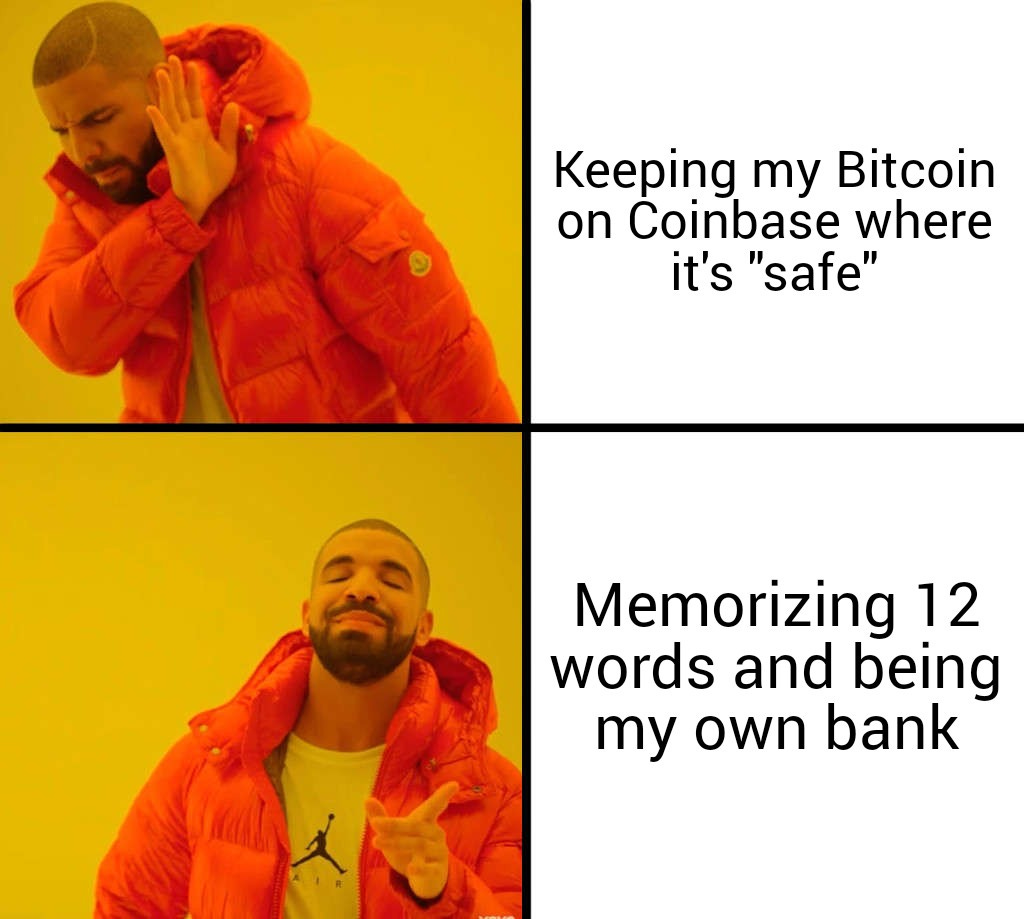
You’re choosing between “someone else might lose my Bitcoin” and “I might lose my Bitcoin.” Both are real risks. The honest assessment requires evaluating your own capabilities: Can you securely store a seed phrase for decades? Will your heirs know how to access your Bitcoin if you die? Are you more likely to fall victim to an exchange hack or to forget where you hid your backup?
There’s no universal right answer. But understanding the actual tradeoffs—not the marketing—is essential.
Your Custody Options: Security Meets Convenience
You have two main paths:
Hardware Wallets: The Digital Vault
These are physical devices (Ledger, Coldcard, Trezor) that generate and store your private keys offline. Want to send Bitcoin? You plug it in, confirm the transaction on the device screen, unplug it.
The keys never touch your computer. Never touch the internet. Malware on your laptop can’t steal them. Hackers on the network can’t access them.
Hardware wallets use secure element chips—the same technology that protects credit cards and passports—to isolate private keys from any connected device [17]. Even if you connect to a computer infected with malware, the malware cannot extract your private keys.
This is for your savings—the Bitcoin you’re holding long-term, your digital gold secured against every threat except your own forgetfulness.
Software Wallets: The Digital Wallet
These are apps (BlueWallet, Electrum, Sparrow) on your phone or computer. More convenient—send and receive with a tap. But the keys live on your device, which connects to the internet.
More vulnerable to sophisticated attacks, but fine for spending amounts—your walking-around money.
The security rule of thumb: Never keep more in a software wallet than you’d carry in a physical wallet on the street [18].
The strategy? Keep most Bitcoin in cold storage (hardware wallet). Keep what you might spend this month in hot storage (software wallet). And when you need to spend that Bitcoin in the real world, you have options. For daily purchases, services like Offramp offer crypto debit cards that let you spend directly from your wallet without converting back to traditional banking systems first.
The Seed Phrase: Your Master Key
When you set up any wallet, it generates a “seed phrase”—typically 12 or 24 random words drawn from a standardized list of 2,048 words. This standard, called BIP39, ensures compatibility across all major Bitcoin wallets [19]. This phrase mathematically recreates all your private keys.
Lose your hardware wallet in a fire? Buy a new one, enter your seed phrase, and your Bitcoin reappears. Your wealth was never in the device—it exists on the blockchain, and the seed phrase is the key.
This makes the seed phrase the most important thing you’ll ever protect.
The rules are non-negotiable:
- Never type it into any computer or phone—keyloggers exist and are common in malware
- Never take a photo—cloud backups compromise it automatically
- Never store it digitally—anything connected to the internet can eventually be hacked
Write it on paper or stamp it into metal (fireproof, waterproof solutions like Cryptosteel or Billfodl exist specifically for this purpose). Store copies in separate secure locations—a home safe and a bank safety deposit box, for example. Some people split it using cryptographic methods like Shamir’s Secret Sharing [20]. Some memorize it (risky—brain injuries, strokes, and dementia happen).
What you absolutely cannot do is lose it. No seed phrase = no Bitcoin. No recovery service. No customer support. No backdoor.
This is the price of sovereignty. The responsibility is yours alone.
The Paradox of True Ownership
And here we arrive at the strange beauty of Bitcoin:
You can store more wealth in your head than Fort Knox holds in its vaults. Fort Knox contains approximately 147.3 million troy ounces of gold, worth roughly $350 billion at 2024 prices [21]. Twenty-four words memorized = access to unlimited Bitcoin from anywhere on Earth. No physical object to carry. No border checkpoint can confiscate it. No authoritarian regime can seize it.
Walk across a border with nothing but the clothes on your back and the seed phrase in your memory. On the other side, access your wealth with a $50 phone and internet connection.
This isn’t theoretical. In 2022, Ukrainian refugees fleeing the Russian invasion used Bitcoin to carry their wealth across borders when traditional banking systems failed and physical cash became impractical to transport [22]. Similarly, activists in authoritarian regimes from Belarus to Hong Kong have documented using Bitcoin to preserve wealth when local bank accounts were frozen for political reasons [23].
This is why some governments fear Bitcoin. Not primarily because it’s used for crime (the UN Office on Drugs and Crime estimates that less than 1% of cryptocurrency transactions are illicit, compared to 2-5% of global GDP for traditional finance) [24]. But because it makes capital controls obsolete. Financial censorship impossible. Wealth confiscation impractical.
For the first time in human history, individuals can own bearer assets that can’t be physically seized, that can cross borders at the speed of light, that require no permission to use. If you’re curious about the deeper philosophical implications of this shift—why certain people find Bitcoin valuable beyond just price speculation—we explored this question from multiple perspectives in Why Bitcoin Has Value: A Question With 8 Billion Different Answers.

But when you need to actually buy or sell Bitcoin while maintaining this level of sovereignty, you face another challenge: most platforms require extensive identity verification. For those prioritizing privacy alongside self-custody, peer-to-peer platforms like SovereignSwap enable direct trading without KYC requirements—matching buyers and sellers directly while you maintain control of your keys throughout the process.
But only if you actually take custody.
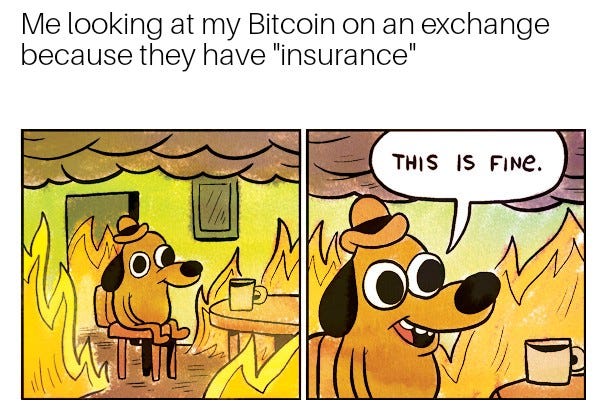
This sovereignty comes with profound responsibility. You become your own bank, your own security team, your own compliance department. The freedom is absolute—but so is the accountability. Every decision about key storage, backup redundancy, and operational security falls entirely on you.
For some, this is liberation. For others, it’s a burden better left to professionals. Both perspectives are valid. The key is making an informed choice rather than defaulting to whatever’s convenient.
## The Choice Before You
You now understand what most Bitcoin owners don’t:
✅ How blockchain solved the double-spend problem without middlemen
✅ Why mining’s energy consumption creates unhackable security
✅ How nodes decentralize power away from any single entity
✅ What happens in every transaction from signature to confirmation
✅ Why exchange custody repeats banking’s failures
✅ The real tradeoffs between exchange custody and self-custody
✅ How self-custody gives you true ownership—and true responsibility
Bitcoin isn’t just an investment. It’s not “digital gold” that you passively hold on an exchange.
It’s a tool for financial sovereignty. For opting out of a system that can freeze your account for political reasons, inflate your savings through money printing, or deny you access to your own wealth.
But that power requires responsibility. Requires understanding. Requires custody.
The question isn’t whether Bitcoin works—it’s been operating 24/7 without a single hour of downtime for over 15 years, processing over 1 billion transactions and securing hundreds of billions in value [25]. It has survived attacks, skepticism, crashes, and the collapse of countless competitors.
The question is: Will you trust someone else to hold it, or will you truly own it?
Related Reading
Ready to take the next step? Our comprehensive guide The Complete Bitcoin Self-Custody Guide for 2026 walks you through the exact steps to secure your Bitcoin—from choosing the right wallet to avoiding the costly mistakes that have lost people their wealth.

Before You Go: One Question
Where do you currently store your Bitcoin?
- Exchange (learning about self-custody)
- Software wallet (considering hardware)
- Hardware wallet (already practicing security)
- Don’t own Bitcoin yet (just learning)
Drop your answer in the comments. And if this made you see Bitcoin differently, share it with someone who still thinks it’s “just a speculative asset” or keeps everything on exchanges.
References
[1] Chaum, D. (1983). “Blind Signatures for Untraceable Payments.” *Advances in Cryptology*; DigiCash bankruptcy documented in *Los Angeles Times*, November 4, 1998.
[2] U.S. Department of Justice. (2007, April 27). “Digital Currency Business E-Gold Indicted for Money Laundering and Illegal Money Transmitting.” Press Release 07-338.
[3] Blockchain.com. (2024). “Bitcoin Hash Rate.” Historical data accessed December 2024.
[4] Cambridge Centre for Alternative Finance. (2024). “Cambridge Bitcoin Electricity Consumption Index.” University of Cambridge.
[5] Bitcoin Core source code, halving schedule; Block 840,000 mined April 20, 2024, confirmed via blockchain explorers.
[6] Federal Reserve Economic Data (FRED). “M2 Money Stock” series, Federal Reserve Bank of St. Louis, 2020-2022 data.
[7] Bitcoin.org. (2024). “Running a Full Node.” Bitcoin Core node requirements documentation.
[8] Bitnodes.io. (2024). “Global Bitcoin Nodes Distribution.” Real-time network statistics, December 2024.
[9] Coindesk. (2017, November 8). “SegWit2x Hard Fork Suspended as Bitcoin Upgrade Loses Support.” Akin, J.
[10] BitInfoCharts. (2024). “Bitcoin Average Transaction Fee.” Historical data 2021-2023.
[11] Nakamoto, S. (2008). “Bitcoin: A Peer-to-Peer Electronic Cash System.” Section 11: Calculations demonstrating probability of successful attack decreases exponentially with confirmations.
[12] Mt. Gox rehabilitation proceedings, Tokyo District Court, 2014-2024; *Reuters*. (2024, July 5). “Mt. Gox Begins Repaying Bitcoin to Creditors After 10-Year Wait.”
[13] Ontario Securities Commission. (2020, June 12). “OSC Staff Notice 51-729: QuadrigaCX: A Review by Staff of the Ontario Securities Commission”; Ernst & Young Monitor’s Reports to Court.
[14] U.S. Department of Justice. (2023, November 2). “FTX Founder Samuel Bankman-Fried Convicted of Defrauding Customers and Investors.” Press Release 23-1081; SEC v. Samuel Bankman-Fried, Case 1:22-cv-10501 (S.D.N.Y.).
[15] Cointelegraph Research. (2023). “The Complete History of Cryptocurrency Exchange Hacks.” Cumulative breach analysis 2014-2018.
[16] Chainalysis. (2023). “The 2023 Geography of Cryptocurrency Report.” Chapter 3: Lost and Inaccessible Coins Analysis.
[17] Ledger. (2023). “Security White Paper: The Secure Element in Hardware Wallets.” Technical documentation.
[18] Bitcoin.org. (2024). “Securing Your Wallet: Security Best Practices.” Community guidelines.
[19] Bitcoin Improvement Proposals (BIP) 39. “Mnemonic code for generating deterministic keys.” GitHub repository: bitcoin/bips/blob/master/bip-0039.mediawiki.
[20] Shamir, A. (1979). “How to Share a Secret.” *Communications of the ACM*, 22(11), 612-613; Applied to cryptocurrency seed backup by multiple wallet providers.
[21] U.S. Mint. (2024, December). “Status Report of U.S. Treasury-Owned Gold.” Official holdings documentation, Fort Knox Bullion Depository.
[22] *Forbes*. (2022, March 14). “How Bitcoin Helped Ukrainian Refugees Flee Russian Invasion.” Kaplan, J.; First-person accounts and transaction analysis.
[23] Human Rights Foundation. (2023). “Financial Freedom in Authoritarian Regimes: The 2023 Freedom Tech Report.” Case studies from Belarus, Hong Kong, and other regions.
[24] United Nations Office on Drugs and Crime. (2023). “Cryptocurrencies and Illicit Finance: Money Laundering and Corruption Risks.” Research report comparing cryptocurrency to traditional finance illicit transaction rates.
[25] Blockchain.com. (2024). “Bitcoin Network Statistics.” Cumulative data: blocks mined, total transactions, and network uptime since Genesis Block (January 3, 2009).