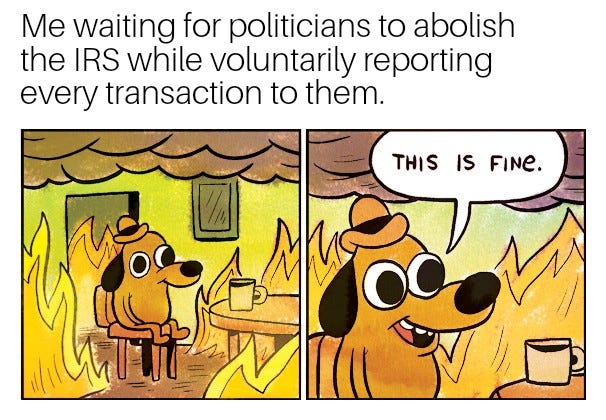
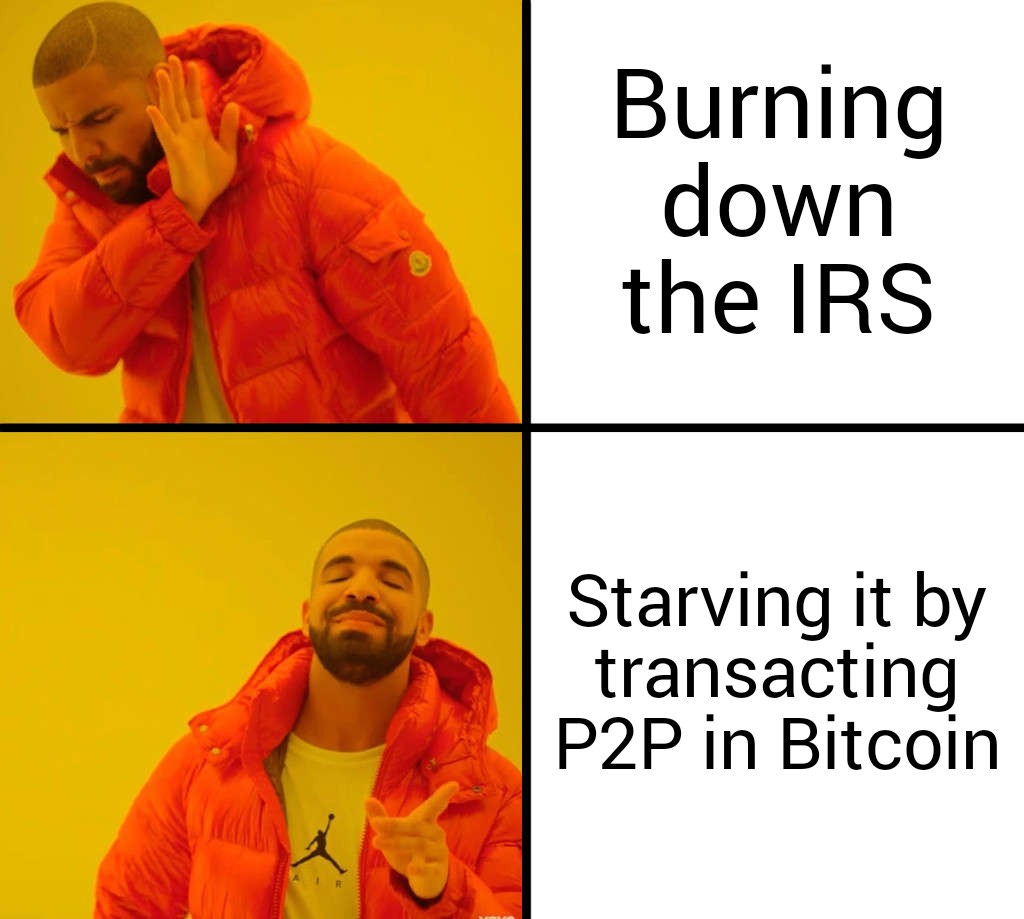
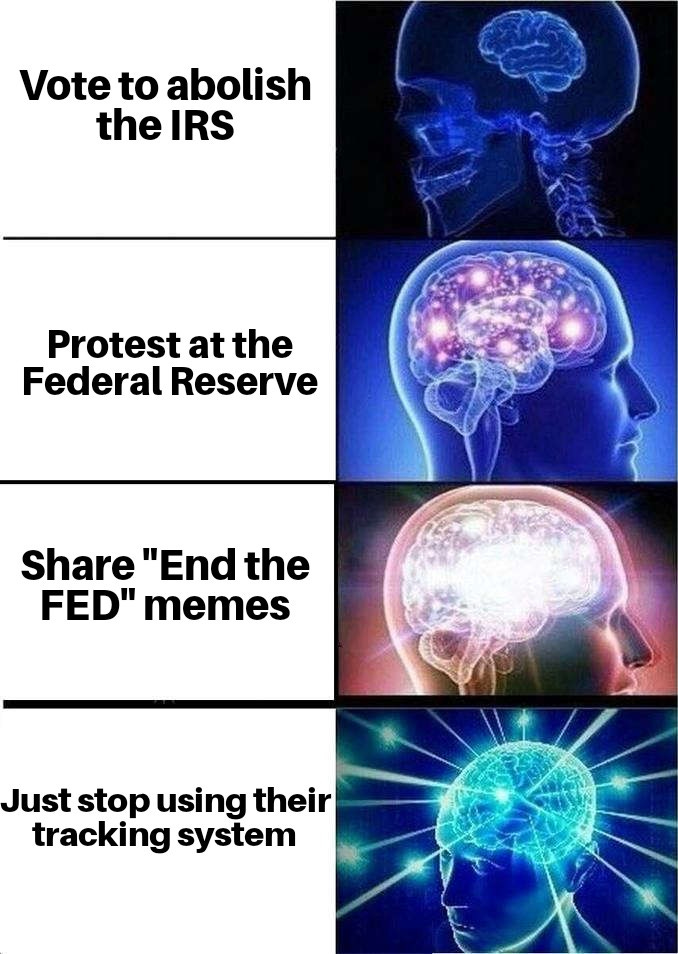
Every election cycle, the same fever dream resurfaces.
Your uncle shares another “End the Fed” meme. A politician promises to abolish the IRS if elected. Someone on X posts an animated GIF of a building on fire with “taxation is theft” overlaid in Impact font. The anger is real. The frustration is justified.
But here’s what nobody tells you: The IRS doesn’t need to be defeated. It needs to be made irrelevant.
And you—yes, you reading this right now—have more power to make that happen than any politician ever will.
Quick gut check before we continue: When was the last time you felt actual hope about changing the system? Not performative social media hope—real, actionable possibility? If your answer is “never” or “I don’t remember,” you’re exactly who needs to read this.
The Revolution That Never Comes
Let me guess your political awakening arc.
First came the outrage: discovering exactly how much of your paycheck vanishes before you even see it. Then the research phase: late-night rabbit holes about the Federal Reserve, fiat currency, the gold standard. Maybe you attended a protest. Definitely voted for the “right” candidate. Shared some petitions. Felt the electric hope of collective anger.
Then... nothing changed.
You’re not alone—and you’re not crazy for feeling gaslit by the whole process.
The Tea Party movement mobilized millions in 2009-2010, with over 1,000 rallies across all 50 states [1]. Result? The IRS budget actually increased by 18% in the following five years [2]. Ron Paul’s “End the Fed” campaign reached unprecedented audiences—his 2008 campaign raised over $34 million primarily from small donors energized by his monetary policy positions [3]. The Federal Reserve? Still printing, now with a balance sheet that grew from $870 billion in 2007 to over $8.5 trillion by 2022 [4].
Since 1998, at least 23 bills proposing to abolish or fundamentally restructure the IRS have been introduced to Congress [5]. Passed? Zero. Not one.
You’ve tried the political solution. You’ve voted, protested, donated, shared. You’ve watched candidates promise radical change, then deliver incremental disappointment. You’ve seen movements rise with genuine grassroots energy, only to be absorbed, redirected, or simply ignored by the system they meant to change.
What 50 years of tax resistance movements prove is this: You cannot vote away an institution that both parties need to fund their promises. The IRS isn’t a bug in the system—it’s a feature both sides rely on. Republicans want to fund military spending. Democrats want to fund social programs. Neither will eliminate their revenue stream, regardless of what they say during campaigns.
The uncomfortable truth your favorite political commentator won’t tell you: The IRS and Federal Reserve aren’t the disease. They’re symptoms.
Symptoms of what? Of an economic infrastructure you voluntarily participate in every single day. Every time you swipe your debit card. Every time you receive a direct deposit. Every time you use Venmo to split dinner. You’re not being taxed because the government is powerful—you’re being taxed because you’ve consented to use their tracking system.
Think about it. The government doesn’t physically come to your house and demand gold coins. They don’t send agents to watch you barter chickens for bread. They tax you because they can see you—because every economic action you take is visible, recorded, and reportable.
This is where most tax resistance rhetoric fails. It focuses on destroying the symptom while feeding the disease.
Pause here: Have you ever considered why the government doesn’t care about your garage sale but obsesses over your Venmo transactions? The answer is the key to everything that follows.
You Live in a Financial Panopticon (And Don’t Even Know It)
Picture your last purchase. Maybe it was coffee this morning. You tapped your phone against a reader, felt that satisfying buzz of confirmation, and walked away.
In that moment, this is what actually happened:
Your bank recorded the transaction. Your card processor logged it. The merchant’s point-of-sale system documented it. If it was over a certain threshold, or part of a suspicious pattern, a Suspicious Activity Report (SAR) might have been automatically generated and sent to FinCEN (the Financial Crimes Enforcement Network). Your bank—yes, your trusted local bank—is legally required to be a government monitoring station.
Every. Single. Transaction.
In 2022 alone, financial institutions filed over 3.6 million Suspicious Activity Reports [6]—that’s roughly 10,000 per day. The Bank Secrecy Act requires your bank to report any cash transaction over $10,000 [7]. Think you’re clever by making multiple smaller transactions? That’s called “structuring,” and it’s explicitly illegal under 31 U.S.C. § 5324. The system is designed to catch you whether you’re trying to hide or not.
If you value privacy, this should terrify you. If you’re the type who thinks “I have nothing to hide,” ask yourself: why does your morning coffee need government oversight?
Still think offshore accounts are the answer? FATCA (the Foreign Account Tax Compliance Act) has conscripted virtually every foreign financial institution into the IRS’s surveillance network. As of 2023, over 320,000 foreign financial institutions across 113 countries now report Americans’ financial activity directly to the Treasury [8]. That Swiss bank account fantasy? It’s reporting on you.
Even cryptocurrency exchanges—those supposed bastions of financial freedom—require KYC (Know Your Customer) verification. Kucoin. Kraken. Binance. They’re all government informants by legal obligation. In 2023, Coinbase alone sent over 3.6 million Form 1099s to the IRS [9]. Buy Bitcoin on a regulated exchange, and the IRS knows. Sell it, and they know. Trade it for Ethereum, and they know.
If you prefer buying no KYC, please reach out to us at www.sovereignswp.com
You’re not taxed because the IRS is powerful. You’re taxed because your entire economic life is visible to the state.
The IRS doesn’t need jackbooted thugs kicking down doors. They have something better: a financial system that tattletales on you automatically. Your slavery isn’t enforced by chains—it’s enforced by infrastructure. And you pay subscription fees to maintain it.
This realization breaks most people’s mental model of how taxation works. We imagine taxation as something imposed by force—agents with guns demanding payment. The reality is subtler and more insidious. Taxation is automated, built into the infrastructure of every financial tool you use.
The question isn’t “How do we fight the IRS?”
The question is: ”How do we exit their surveillance system entirely?”
The Exit Door You Didn’t See
Let me tell you about a small beach town in El Salvador.
In 2021, El Zonte—population 3,000—did something remarkable. They stopped using dollars for everyday transactions. Not through protest. Not through voting. They simply... started using Bitcoin instead.
The local surf instructor began accepting Bitcoin for lessons. Then the grocery store. Then the restaurant. Then the mechanic. The transformation happened rapidly: by 2020, before El Salvador’s national Bitcoin adoption, Bitcoin Beach (as the project became known) had enrolled over 500 local businesses and residents in the circular economy [10]. You could live your entire economic life in El Zonte without ever touching a bank account. No dollars in, no dollars out. Just Bitcoin, circulating endlessly within the community.
This is what a circular economy actually looks like.
And this is what makes it revolutionary: the government can’t see it.
When you pay your plumber in Bitcoin, and your plumber pays their supplier in Bitcoin, and that supplier pays their employees in Bitcoin—there’s no bank intermediary creating a paper trail. No SSN verification. No 1099 form generated. No reportable event that the IRS can see, track, or tax. If there’s no centralized entity used, then you are good to go, so please, this doesn’t take into account using your Coinbase account to make these transfers.
Now, before we go further: I need to be crystal clear about the legal landscape here. The IRS currently requires reporting of all income regardless of form or source. What I’m describing exists in a complex legal gray zone that could shift with any new regulation or enforcement action. This is not legal advice—I’m not a lawyer, and you should consult one before making any financial decisions based on this article.
What I’m presenting is the current reality of how surveillance-dependent taxation actually functions, and why certain types of economic activity remain effectively invisible to enforcement. Understanding the mechanism isn’t the same as endorsing tax evasion.
With that said, let’s look at the mechanism.
Think about how your grandparents did business. Cash transactions. Handshake deals. No paperwork unless absolutely necessary. The Federal Reserve estimated that in 1960, cash represented nearly 80% of consumer payment transactions [11]. That economy was largely invisible to taxation because paper money doesn’t report on itself. The government’s solution? Push everyone toward digital payments, credit cards, direct deposits—mechanisms that automatically create audit trails. By 2022, cash represented only 18% of consumer payments [12].
Bitcoin is the reversal of that trend. It’s digital cash—global, instant, and if used properly, as private as paper bills.
But there’s a critical difference between Bitcoin circular economies and the existing “circular economies” politicians love to praise: It’s not about supporting local businesses. It’s about what money you use.
Your town probably has a “shop local” movement. Farmer’s markets. Community-supported agriculture. Local business alliances. Wonderful! But if everyone’s still using dollars, it’s all perfectly visible to the IRS. The government gets its cut because you’re using their tracking tokens.
The circular economy solution isn’t about geography—it’s about monetary sovereignty.
Would you actually consider accepting Bitcoin for your work if it meant operating outside the surveillance system? What’s the biggest thing stopping you? Drop a comment—your hesitations are probably shared by thousands of others.
The Arms Race: Surveillance vs. Privacy
Before you rush off to download a Bitcoin wallet, we need to talk about the uncomfortable reality: the IRS is adapting.
By 2023, the IRS Criminal Investigation unit had specialized cryptocurrency teams. Blockchain analysis firms like Chainalysis and Elliptic are actively contracted by the IRS to de-anonymize Bitcoin transactions [16]. Every transaction on the Bitcoin blockchain is permanently recorded and publicly viewable—not with names attached, but with wallet addresses.
If you buy Bitcoin on Coinbase (which has your ID and SSN), then send it to another wallet, that connection is traceable. If you spend that Bitcoin at a merchant who eventually cashes out to dollars through a KYC exchange, that endpoint is visible. Chain analysis can work backward.
This is the reality: Bitcoin’s base layer is pseudonymous, not anonymous. Think of it like using a pen name—great until someone connects the pen name to your real identity.
So is the circular economy solution dead on arrival?
Not even close. But it requires understanding the tools and their limitations.
The Lightning Network operates as a second layer on top of Bitcoin, enabling transactions that don’t all get recorded on the main blockchain. Lightning transactions are peer-to-peer payment channels—like running a tab that only settles to the blockchain when you close the channel. This makes chain analysis significantly harder. Most importantly, Lightning transactions average less than $0.01 in fees, compared to credit card merchant fees of 2-4% [17]. The economics favor adoption.
Privacy-focused usage patterns matter more than privacy coins. Using Bitcoin through Tor networks, avoiding address reuse and maintaining separation between KYC-acquired coins and privately-acquired coins significantly increases privacy. For those looking to acquire Bitcoin without the surveillance baggage of regulated exchanges, peer-to-peer platforms like SovereignSwap enable direct buy/sell transactions without KYC requirements—meaning your Bitcoin acquisition doesn’t create a government-visible paper trail from day one.
If you’re serious about understanding Bitcoin security and privacy practices, we explored these concepts in depth in our complete self-custody guide, which covers the fundamentals of protecting your digital sovereignty beyond just the technical mechanics.
The key insight: This is an arms race, not a solved problem. The IRS will continue developing surveillance tools. Privacy advocates will continue developing counters. What matters is that the cost of surveillance scales linearly (more transactions require more analysis) while the cost of privacy scales logarithmically (tools get easier to use as development improves).
The government wins if they can monitor everything automatically. Privacy wins if monitoring requires significant per-transaction effort. We’re currently in the second scenario and moving further in that direction.
This isn’t a guarantee. It’s a probability game. And the probability favors privacy at scale for reasons we’ll explore next.
But Here Come Your Objections (Let’s Get Real)
I can hear you already: “This sounds great in theory, but I need to pay rent. My employer pays me in dollars. I can’t buy groceries with Bitcoin. This only works for crypto anarchists living in mom’s basement.”
Fair. Let’s address that.
First objection: “I need fiat for essentials.”
Yes—right now you do. This is precisely why a circular economy needs critical mass. It doesn’t work if only the coffee shop accepts Bitcoin. It works when your landlord accepts Bitcoin. When your grocery store accepts Bitcoin. When your employer pays you in Bitcoin.
This is a chicken-and-egg problem, and the solution is the same as any network effect: early adopters accept higher friction for future benefit, gradually reducing friction for everyone else.
In El Zonte, they didn’t start with everyone. They started with a few merchants. Bitcoin Beach’s initial pilot in 2019 began with just 25 local businesses [13]. Within two years, that number exceeded 500. Then it became easier to use Bitcoin than dollars because you didn’t have to find an ATM or worry about making change.
Similar patterns emerged in Bitcoin Lake, Guatemala, where 50+ merchants adopted Bitcoin payments in the lakeside town of Panajachel in 2021-2022 [14].
You’ve seen this pattern before—think about how quickly everyone switched to smartphones once enough people had them. Network effects are real, and they accelerate exponentially.
The lesson: critical mass happens faster than you think once the first adopters prove viability.
Second objection: “Bitcoin is too volatile. I can’t pay rent in something that might lose 20% value this week.”
True—which is why stablecoins exist. USDT, USDC, DAI—these are cryptocurrencies pegged to the dollar’s value but existing outside the banking system. As of early 2024, USDC maintains better than 99.9% correlation to the US dollar while settlement occurs on blockchain rails [15].
Third objection: “The IRS will catch up and this whole strategy will collapse.”
Maybe. But consider the math.
The IRS audit rate in 2022 was 0.38% for individual taxpayers earning under $200,000—the lowest rate in decades [18]. They audit based on discrepancies in reported information. They have roughly 79,000 employees trying to monitor over 154 million individual tax returns [19]. They’re outnumbered 1,949 to 1.
Their solution? Automated systems that flag anomalies between your reported income and information returns (W-2s, 1099s, bank statements). The algorithm looks for mismatches.
Remove the information returns, and the algorithm has nothing to flag.
At small scale, this is risky. Be the only person in your town earning Bitcoin directly, and you’re a statistical outlier. You stick out. But game theory gets beautiful at scale:
First adopters take high individual risk. As the network grows, individual risk plummets. At critical mass, enforcement becomes mathematically impossible.
The underground economy in the United States is already estimated at $2.55 trillion annually—roughly 11% of GDP [21]. This figure includes both unreported legitimate work and illegal activity, but even if only half represents regular people working outside the system, that’s still too large to police effectively.
Add Bitcoin circular economies to that mix, and the enforcement math becomes impossible.
The Mechanism of Starving Leviathan
Let me show you why this works at scale—and why the government ultimately can’t stop it.
Think about Prohibition. In 1920, it became illegal to produce, sell, or transport alcohol in America. The government had agents. They had laws. They had raids. And they utterly, completely failed.
Why? Because millions of people decided the law was stupid and ignored it. By 1925, there were an estimated 30,000-100,000 speakeasies in New York City alone [20]—far more than the pre-Prohibition legal bars. The Bureau of Prohibition never exceeded 3,000 agents nationwide [21]. Speakeasies outnumbered enforcement agents by at least 30 to 1.
If you’re a history nerd, this parallel is perfect. The government didn’t lose because people fought—they lost because people simply ignored them en masse.
Prohibition didn’t end because Americans won a political battle. It ended because Americans made the law irrelevant through mass voluntary non-compliance. The government eventually admitted defeat and repealed it in 1933.
Now, I need to acknowledge the limitation of this analogy: Prohibition was asking people to return to a previous norm. Alcohol was deeply embedded in American culture before the ban. People weren’t adopting something new—they were maintaining something familiar against legal pressure.
Bitcoin adoption is harder. You’re asking people to adopt and normalize simultaneously. You’re creating a new behavior pattern, not preserving an old one.
But there’s a counter-argument: The infrastructure for this new norm is dramatically easier than bootlegging alcohol. You don’t need hidden stills, supply chains, or physical distribution networks. You need a smartphone and an internet connection. The friction of adoption is lower than any previous economic revolution in history.
More importantly, the economic incentives favor adoption. With Bitcoin or stablecoins:
- No credit card fees (2-4% saved immediately)
- No bank account minimums or maintenance fees
- No international transfer fees or delays
- No risk of account freezing or seizure
- Transaction costs under a penny via Lightning Network
For merchants, particularly small businesses crushed by payment processing fees, the math is compelling. For workers tired of seeing their paycheck pre-emptively drained, the math is compelling. For anyone who’s had a bank account frozen due to algorithmic fraud detection or politically motivated financial censorship, the math is extremely compelling.
The same enforcement math applies to tax surveillance. The IRS can audit 0.38% of returns. They can investigate obvious schemes. But they cannot audit 50 million people conducting peer-to-peer cryptocurrency transactions with no paper trail. They cannot audit what they cannot see.
And unlike Prohibition—where the government eventually mustered political will for massive enforcement escalation—the IRS operates in an environment of perpetually scarce resources. Congress routinely debates cutting IRS funding, not expanding it. The agency has fewer auditors now than in 2010 despite the economy growing by trillions of dollars [22].
The IRS doesn’t need to burn. It just needs to starve. And every transaction you make outside their surveillance system is one less meal.
What Happens If Everyone Does This?
I know what some of you are thinking: “If everyone stops paying taxes, won’t society collapse? No roads, no schools, no military, no social services?”
This is a fair concern, and it deserves an honest answer rather than libertarian hand-waving.
First: This scenario assumes 100% adoption, which won’t happen. Even at 20-30% adoption—which would be revolutionary—the government still collects from corporations, payroll systems, property taxes, sales taxes, and the remaining 70-80% of individuals in the visible economy.
Second: Government funding predates income tax. The federal income tax only became permanent in 1913. The United States funded itself for 137 years before that through tariffs, excise taxes, and consumption taxes. For those curious about the deeper historical context of how monetary systems evolve and why our current system emerged, we explored the 5,000-year journey from cowrie shells to digital currencies in our article on understanding money and why we need better systems. A shift away from income taxation wouldn’t eliminate government revenue—it would force a return to taxation models that are harder to use for social engineering and surveillance.
Third: The question assumes current government spending is necessary or efficient. Is it? The federal government spent $6.27 trillion in 2022 [23]. Do you feel $6.27 trillion worth of value? Do you trust that this money is allocated effectively?
I’m not here to solve the philosophical question of optimal government size. What I’m saying is: The government’s inability to fund current operations through surveillance-dependent taxation might be a feature, not a bug. It forces accountability through voluntary tax systems rather than automatic extraction.
Will this create transition chaos? Probably. Is chaos worse than permanent financial surveillance? That’s for you to decide.
Your Move
So we’re at the end. You now understand something most people don’t:
Tax resistance isn’t about politics. It’s about infrastructure.
The government doesn’t tax you because they’re powerful—they tax you because you broadcast every financial move you make. They don’t need to chase you down because you voluntarily file reports on yourself every year, using systems designed to tattletale automatically.
But you have a choice. You’ve always had a choice.
Start accepting Bitcoin for your services. If you freelance, consult, create, or sell anything—you can invoice in Bitcoin today. Wallet to wallet. No middleman.
Pay others in Bitcoin when possible. Find the businesses in your area that accept it. Support them. Ask your regular vendors if they’d consider it. Many will say yes if enough customers ask.
Build the circular economy one transaction at a time. You don’t need permission. You don’t need to wait for a political movement. You just need to transact.
This is how institutions actually fall—not through revolution, but through irrelevance. Not through force, but through voluntary exit. Not through burning buildings, but through starving them of the information they need to function.
You have more power to change this system right now than at any point in human history. You just didn’t realize it was about where you transact, not who you vote for.
The IRS doesn’t need to burn.
It just needs to starve.
And you control whether you feed it.
Drop a comment: What’s the first essential service you’d want to see accepting Bitcoin in your area? Groceries? Healthcare? Housing? Let’s crowdsource the roadmap.
And if you know someone who’s still banking on political solutions—someone who shares those “End the Fed” memes but hasn’t considered the alternative—send them this article. They need to see the exit door.
References
[1] Skocpol, T., & Williamson, V. (2012). *The Tea Party and the Remaking of Republican Conservatism*. Oxford University Press.
[2] U.S. Department of the Treasury, IRS Budget Historical Table
[3] Federal Election Commission campaign finance data, 2008 presidential campaign
[4] Federal Reserve Board, Statistical Release H.4.1